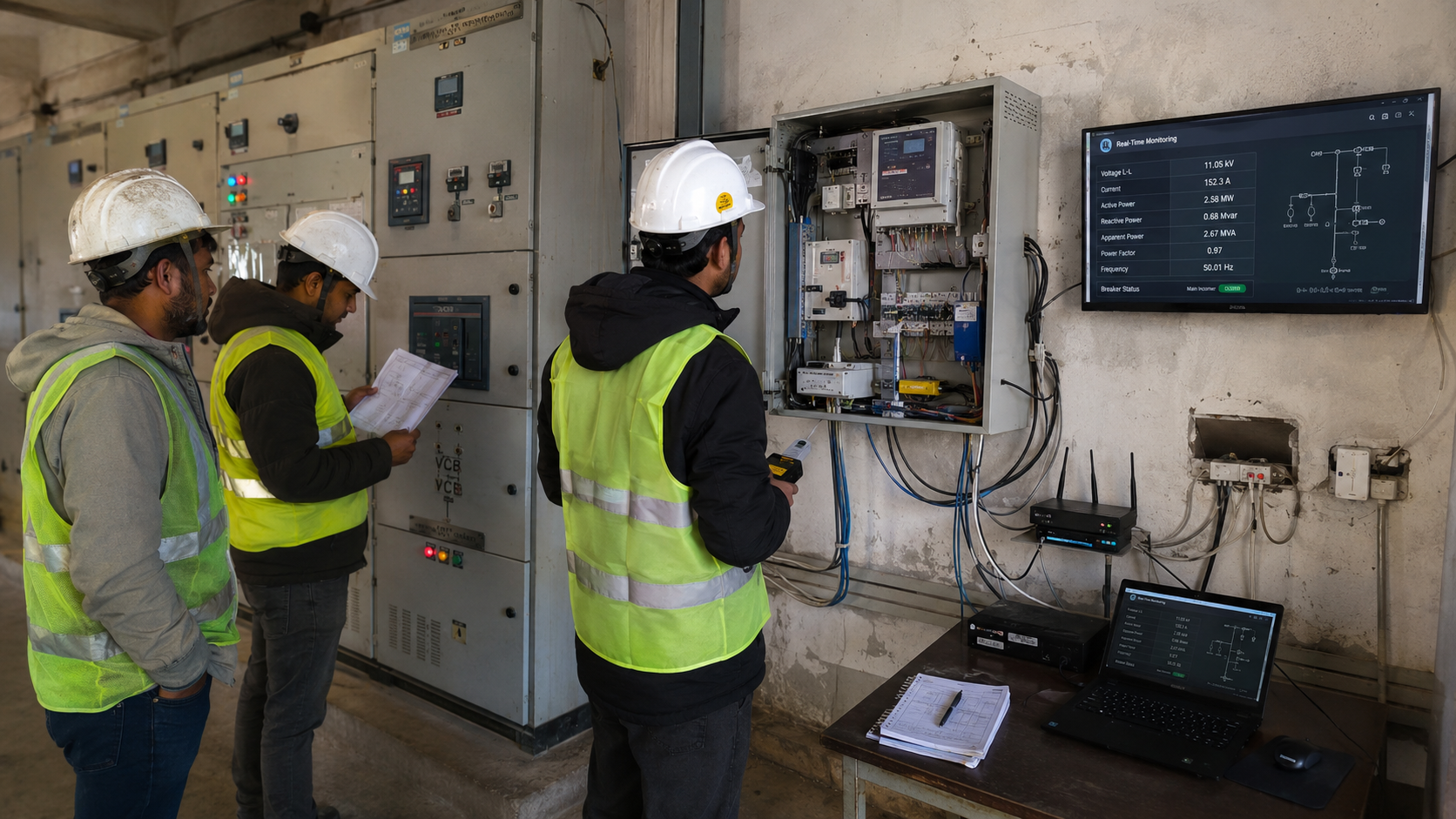
Smart Metering System for Real-Time Industrial Load Monitoring
Supply, installation, and commissioning of a smart meter telemetry system for real-time industrial load monitoring at Narayani Ispat Limited.
Project Overview
Overview
This project involves the supply, installation, and commissioning of a smart meter telemetry system designed for real-time monitoring of industrial electrical parameters. The system enables accurate measurement and transmission of key electrical data, including power, current, frequency, power factor, and circuit breaker status, to the Nepal Electricity Authority (NEA) Load Dispatch Center (LDC).
In addition to real-time monitoring, the system supports remote operation of circuit breakers, facilitating improved load management, faster response to grid conditions, and enhanced coordination between industrial consumers and the central power system. This contributes to increased operational efficiency, system reliability, and better grid control for NEA.
Objectives
The project was designed to achieve the following goals:
- To establish reliable and secure communication between industrial smart meters and the central SCADA system
- To enable real-time monitoring of critical industrial electrical parameters at the NEA Load Dispatch Center (LDC)
- To facilitate remote operation and control of circuit breakers for improved load management and grid stability
- To ensure secure and protected data transmission through a firewall and a gateway-based communication architecture
- To develop a scalable and standardized solution capable of integrating multiple industrial consumers across Nepal into a unified monitoring system
Key Deliverables
The following systems, instruments, and functionalities were supplied, installed, and successfully commissioned as part of the project:
- Implementation of a real-time industrial load monitoring system for continuous data visibility
- Deployment of remote circuit breaker control functionality, enabling efficient grid and load management
- Establishment of a secure industrial communication infrastructure for reliable data exchange
- Provision of dual communication channels (broadband primary with GSM backup) to ensure high system availability and redundancy
- Integration with the NEA SCADA system using the IEC 60870-5-104 protocol for standardized data communication
- Reliable and continuous transmission of critical electrical parameters to the NEA Load Dispatch Center (LDC)
Challenges
The project involved several technical, procurement, and process-related challenges that required careful planning and coordination to ensure successful implementation:
- Ensuring secure and reliable industrial communication while maintaining seamless SCADA integration
- Maintaining consistent and real-time data transmission for accurate monitoring and operational decision-making
- Integrating dual communication infrastructure, including broadband primary and GSM backup systems, to ensure redundancy and high system availability
- Aligning telemetry integration with NEA Load Dispatch Center (LDC) operational standards and real-time control requirements
- Coordinating between multiple stakeholders and technical teams to ensure smooth system deployment and commissioning across industrial sites
Impact
The implementation of this solution has significantly transformed how industrial load management is monitored and controlled by NEA-LDC:
- Previously, industrial power consumption could not be monitored in real time, limiting visibility and operational control at the Load Dispatch Center
- With this system in place, NEA-LDC can now monitor industrial load in real time, enabling accurate assessment of demand and system conditions
- The solution allows remote control of circuit breakers, enabling NEA-LDC to manage excess load during low-demand periods and maintain grid balance
- This improved visibility and control help prevent overloading, enhance grid stability, and support efficient load management across the system
- Real-time monitoring and control capabilities have significantly improved operational responsiveness and decision-making at the dispatch level
Conclusion
The project successfully implemented a smart metering telemetry system for real-time monitoring and control of industrial electrical loads, enabling a significant shift from conventional non-real-time monitoring to an advanced, data-driven grid management approach. It established effective and reliable communication between industrial consumers and the Nepal Electricity Authority (NEA) Load Dispatch Center (LDC), thereby improving overall grid visibility and operational coordination.
With capabilities such as real-time data acquisition, remote circuit breaker control, and secure communication infrastructure, the system has enhanced load management efficiency, improved grid reliability, and reduced the risk of power system disturbances. The ability for NEA-LDC to monitor industrial demand in real time and respond dynamically during low-load and peak-load conditions has further strengthened system stability and operational control.
Overall, the successful implementation demonstrates the effectiveness of smart telemetry systems in modern power distribution networks and provides a strong foundation for scalable deployment across multiple industries in Nepal, supporting future advancements in smart grid development.
Inspired by What You See?
We can help you bring similar innovations to life