Lighting Nepal’s Gateway: Apron High-Mast Illumination at Tribhuvan International Airport
Overview
Night operations depend on more than runway lighting. On the apron, visibility affects every aircraft turnaround, every service vehicle movement, every marshalling cue, and every safe step taken by ramp personnel. At Tribhuvan International Airport (TIA), where traffic is heavy and airside space is limited, apron lighting is part of operational safety.
Mahavir Shree International Pvt. Ltd. (MSI) supplied, installed, tested, and commissioned the Apron Mast Lights and Accessories Installation project at TIA, delivering high-mast lighting, LED floodlights, and obstruction lighting across key apron, helipad, cargo, and parking areas. The project strengthened night-time visibility in one of South Asia’s most operationally constrained airport environments.
Why This Project Mattered
TIA is Nepal’s busiest international airport and the country’s primary aviation gateway. Aircraft parking, pushback, towing, loading, unloading, and servicing continue well after daylight hours. That makes apron lighting a frontline operational requirement, not a secondary convenience.
Poor apron lighting creates practical risk. Shadows affect depth perception. Glare interferes with pilots, controllers, and ground staff. Uneven illumination complicates movement around wings, engines, stairs, loaders, and vehicles. In a live airport environment, the difference between “some light” and “good light” is operationally significant.
TIA adds another layer of complexity. The airport operates inside a tight urban footprint in Kathmandu. Expansion options are limited. Capacity and safety improvements therefore depend heavily on upgrading existing infrastructure while the airport remains active.
That is the environment MSI worked in: limited space, continuous aircraft movement, strict access control, and no room for casual execution.
What MSI Delivered
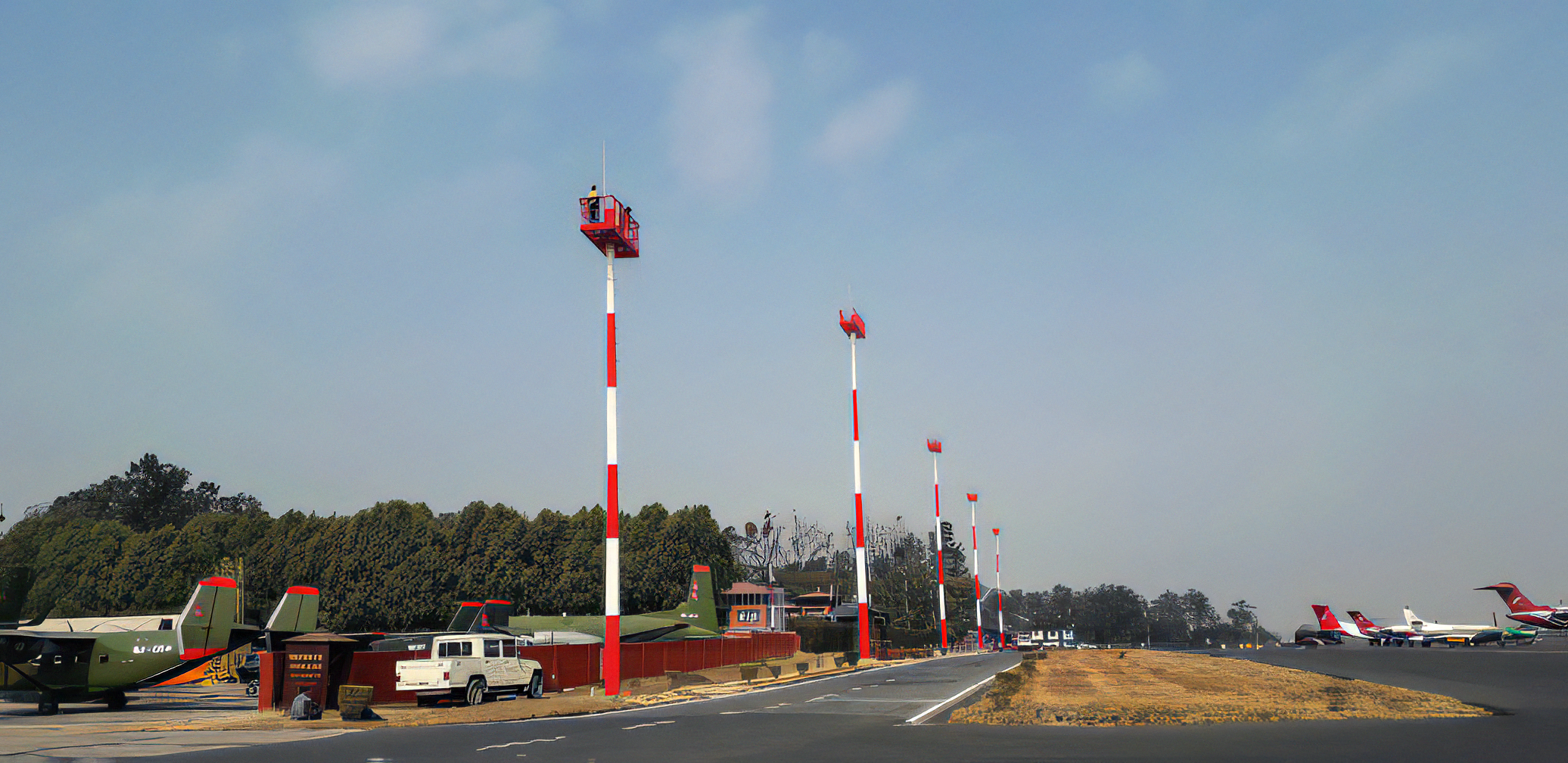
MSI installed 11 high-mast lighting systems using Valmont towers in 25 m and 16 m heights. These were deployed across apron and airside work zones to improve coverage in operationally important areas.
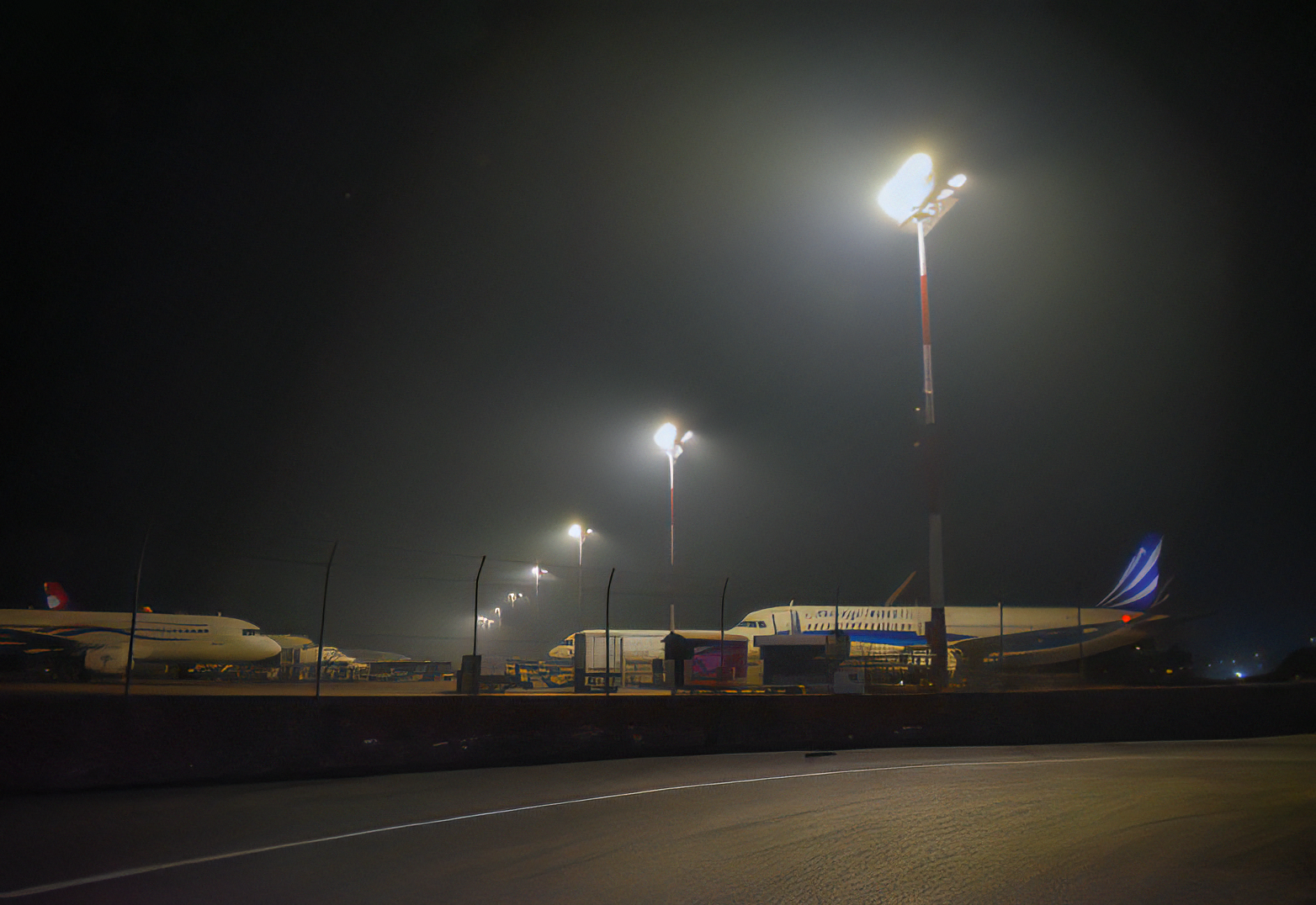
MSI installed CREE LED flood lights in 420 W and 523 W variants to provide high-output apron illumination with strong optical performance. These luminaires were selected for demanding high-mast applications where reach, uniformity, and controlled light distribution matter more than simple brightness.
MSI also installed AV lite twin aircraft obstruction lights on the mast structures so that tall towers remained clearly marked for aviation safety at night.
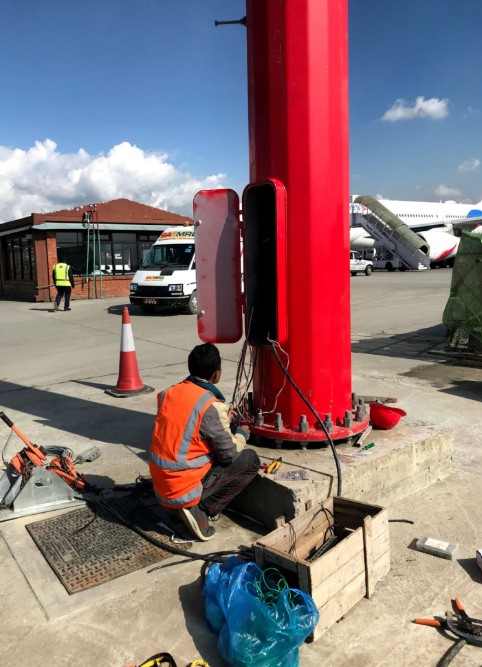
The electrical arrangement was designed for operational control and maintainability. MSI integrated supply from the parking and power station, provided separate MCC feeds for individual masts, and installed individual MCB protection for isolation and fault management. Apron floodlights were integrated with Air Traffic Control tower control, while selected domestic-area lighting operations used timer-based control.
This was not only a lighting installation. It was a controlled airside electrical and operational integration project.
Where the Work Was Executed
MSI structured the project into four packages, allowing work to move zone by zone while airport operations continued.
Package A covered two high masts at the domestic apron near the VVIP lounge.
Package B covered the helipad installation area.
Package C covered LED flood lights at bays 5, 6, and 7.
Package D covered cargo parking and additional airside areas.
This packaging mattered. At an active airport, apron areas cannot simply be shut down for convenience. Work has to be broken into manageable blocks, coordinated around aircraft movements, and executed under tightly controlled access and safety conditions.
How MSI Executed It
MSI delivered the project inside a live airport without disrupting day-to-day operations. That required sequencing, coordination, and discipline.
MSI coordinated installation activities around operational windows, apron use, and restricted airside access. The team worked across shifting site conditions while maintaining compliance with airport safety requirements. Execution also had to account for weather conditions, operational sensitivity, and the realities of working in Kathmandu’s airside environment.
This is where airport infrastructure projects become interesting. The engineering is only part of the story. The real challenge is doing precise technical work in a place where aircraft schedules, safety controls, and operational uptime always come first.
MSI’s execution approach showed that balance clearly: package the work, control the footprint, coordinate continuously, and deliver without interrupting the airport’s core function.
What the Project Achieved
MSI delivered a functioning apron lighting system that improved illumination across aircraft stands, remote parking, helipad-related areas, cargo parking, and other airside zones.
MSI enabled better visibility for taxiing aircraft, apron movement, ground handling, and night operations.
MSI improved the usability of critical apron areas during low-light conditions.
MSI integrated lighting control into airport operations through tower control and timer-based arrangements.
MSI completed testing and commissioning jointly with the client team to verify operational performance.
The result was not just a visual upgrade. It was an operational upgrade.
Better lighting supports safer movement. Safer movement supports faster handling. Faster and more reliable handling supports airport efficiency. At a busy airport like TIA, that chain matters.
The shift to LED also brought longer-term value. High-output LED systems typically reduce energy use and lower maintenance frequency compared with older technologies. In high-mast airside environments, that matters because maintenance access is difficult, downtime is disruptive, and reliability is essential.
Why This Case Study Stands Out
This project is a strong example of how MSI delivers in sensitive operating environments. MSI did not simply supply hardware. MSI installed, integrated, controlled, and commissioned a system that had to perform in real airport conditions.
The project also shows something important about airfield lighting: success is not measured only by lux levels or tower counts. Success is measured by whether the apron becomes safer, clearer, and more workable at night without compromising ongoing operations.
At Tribhuvan International Airport, MSI delivered exactly that: a high-mast apron lighting system that strengthened night-time safety, supported aircraft operations, and improved the functionality of Nepal’s busiest airport.
Pranav Khemka
Infrastructure Specialist at MSI
Our team of expert engineers and consultants brings decades of experience in infrastructure development, delivering innovative solutions across various industries.
Ready to Start Your Next Project?
Let's discuss how we can help you achieve your infrastructure goals. Our expert team is ready to deliver innovative solutions tailored to your specific requirements.
Related Articles
Upper-Air Radio Sounding System in Nepal
New Runway edge approach along frangible masts at TIA